

Photo: Anna Fàbrega


Photo: Anna Fàbrega



Laia Estruch regards the voice as an extension of the body endowed with a spatial sense, an urge to act and full discursive capacity. In the voice, a wide range of questions that allude to language, gender and social structures is manifest; the voice can signal connections and breaks, and the privilege implied by basing a public exhibition on it often leads us to ask: who has a voice? Who has the capacity to formulate a thought and disseminate it? We must not ignore the fact that to raise one’s voice is to demand to be heard, and that pricking up your ears is also a way of acting and taking sides.
Crol (Front Crawl) is a fluid project that proposes a dialogue between two amenities that are next door to each other but which are used for different purposes: Espai 13 of the Fundació Joan Miró and the diving pool of the Montjuïc Municipal Pools. The project breaks down the boundary between these two spaces and through this collapse questions the validity of certain paradigms that govern them: on the one hand, the wet, open and shifting space of the pool; and on the other, the dry, enclosed and firm space of Espai 13. This contradiction is reflected in some of the binomials that Laia Estruch addresses in her art, such as the classic distinction drawn between the body and the voice or, in the particular case of Crol, between hydrophobia and hydrophobia.
Astrida Neimanis puts forward the notion of the ‘embodied hydrocommons’ to define the interdependent relationship between bodies, a bond manifested in their permeable nature and in the fact that the body depends on the circulation of liquids in order to function correctly. This idea not only describes a deep and ineluctable connection between bodies – a common space – but also dismisses the Western and ocularcentric notion that regards bodies as separate entities. According to Neimanis, water has served to interconnect us surreptitiously since time immemorial.
Laia Estruch sees the swimming pool as an experimental biotope in which the addition and removal of organic and chemical substances favours some forms of life while preventing others from proliferating. A space in which a series of processes invisible to our eyes is triggered, among them the oxidation of pathogenic agents and other organisms of an infectious nature. For good reason, the modern swimming pool and its popularisation were connected to the triumph of hygienist precepts and to the optimisation of water treatment, to technologies that enable water to be filtered, and to the introduction of chlorination as a preventive measure. The pool is one of a number of structures used to store, redistribute and supply water. Constructions that enable a basic resource to be strategically managed and which have become an object of interlocution in the artist’s recent work.
In addition, however, a series of techniques that make it possible to pass through water are also be found in the pool. According to Laia Estruch, acquiring the ability to swim is the outcome of one’s determination to conquer an alien medium and, at the same time, of one’s desire to cross a geographical boundary. Floating, the most basic of these techniques, announces the instant prior to immersion or the moment after emergence. An intermediate state in which bodies remain in suspension exactly at the point at which gas and water converge. The membrane that forms the border between inside and out is an aggregation of matter of different consistencies and strengths, an amalgam that establishes the demarcation between what is audible and what is not. Crol grew out of research into water as a conductor for the voice and explores the pool as a vast archive that contains narratives, material memory and silences.
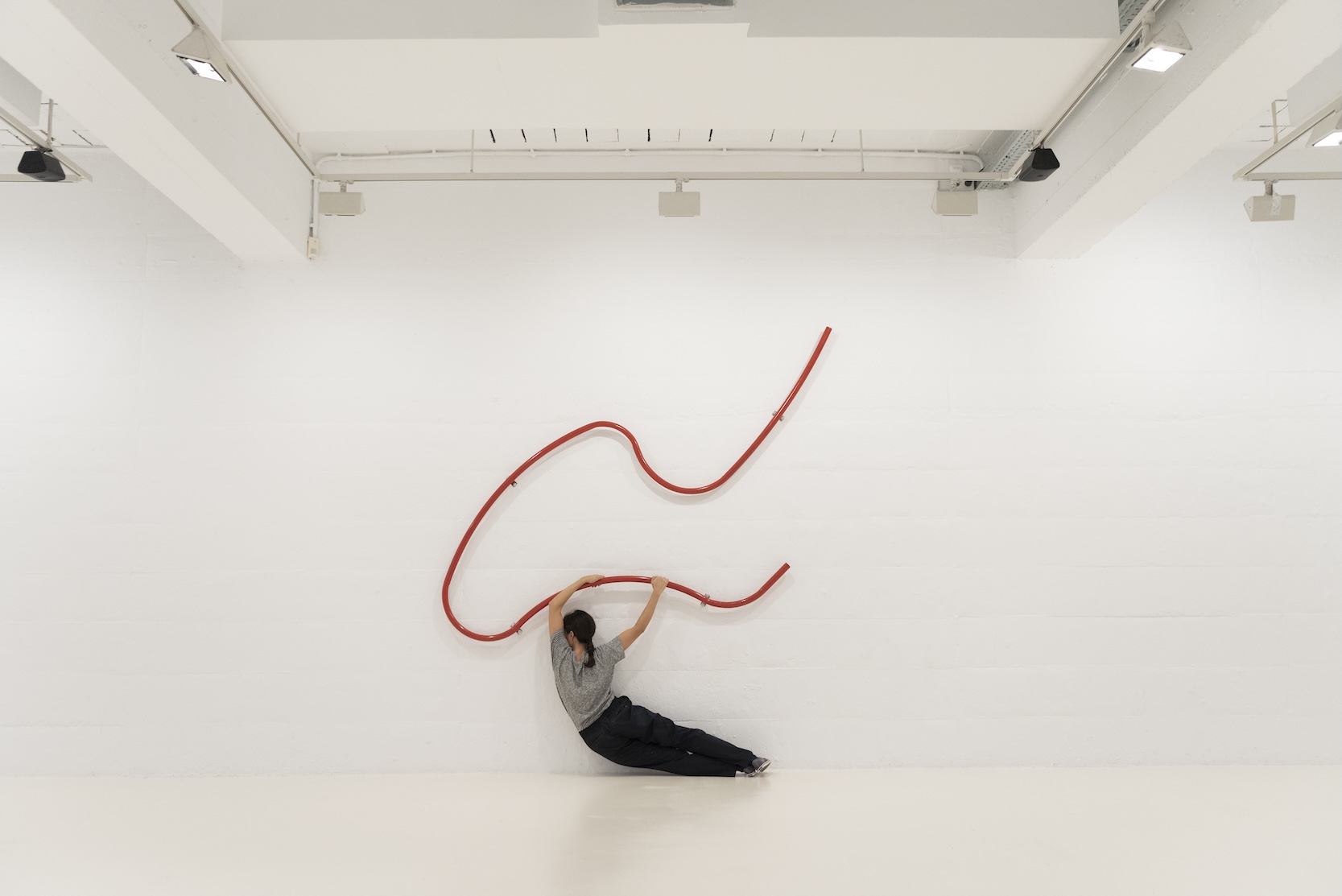
In the context of the exhibition room, a series of inflatable and metal objects calls to mind systems for bolting and fixing things in place. These structures behave like a circuit that alters the body’s course, design a route and define the internal structure of the performance. Laia Estruch has continuously explored this territory of friction between the body and the structure, a soft or hard border that is more than scenographic and is instead an active element: a collaborative agent that impacts on form and content, that dictates the action and accompanies the word. In Crol, this ‘border’ presents a modular configuration that is arranged in various ways, enabling variations in length, order and distribution. As a result, the narrative established by the inflatables suggests numerous versions based on the same melodies, motifs and vocal exercises. Once again, the voice and singing act as a structural phenomenon and allow us to establish a relationship between the various elements that make up this proposal. Taking as her starting point research focused on oral traditions connected to water, Laia Estruch uses underwater recordings and improvisation to define the sound imaginary of Crol, in which the fragmentary and abstract style announces a taste for language that dwells on the morphology of the word, on its plasticity and malleability.
The project lays emphasis on the rethinking of installations which, though they have a long history and a wealth of tradition, acquired their current form in 1992 thanks to the Olympic Games in Barcelona. The particular case of these swimming pools, their symbolic character, their architecture, the urban transformation surrounding them and their current uses are reminders of Montjuïc mountain’s close association with water. At the same time, they introduce an idea of the pool as old as its invention: that the pool is a place representative of urban life that restores our hope of living together as a democracy.
Marc Navarro, Crol (CAT) (PDF)
Marc Navarro, Crawl (EN) (PDF)
Marc Navarro, Crol (ES) (PDF)